Peregrin
A vehicle-native audio system that communicates the internal states of an AI assistant during transit. Peregrin will listen, think, respond, and clarify while employing sound, pacing and haptic cues as an agentive cooperator.
Photo by Eyosias G
Principles
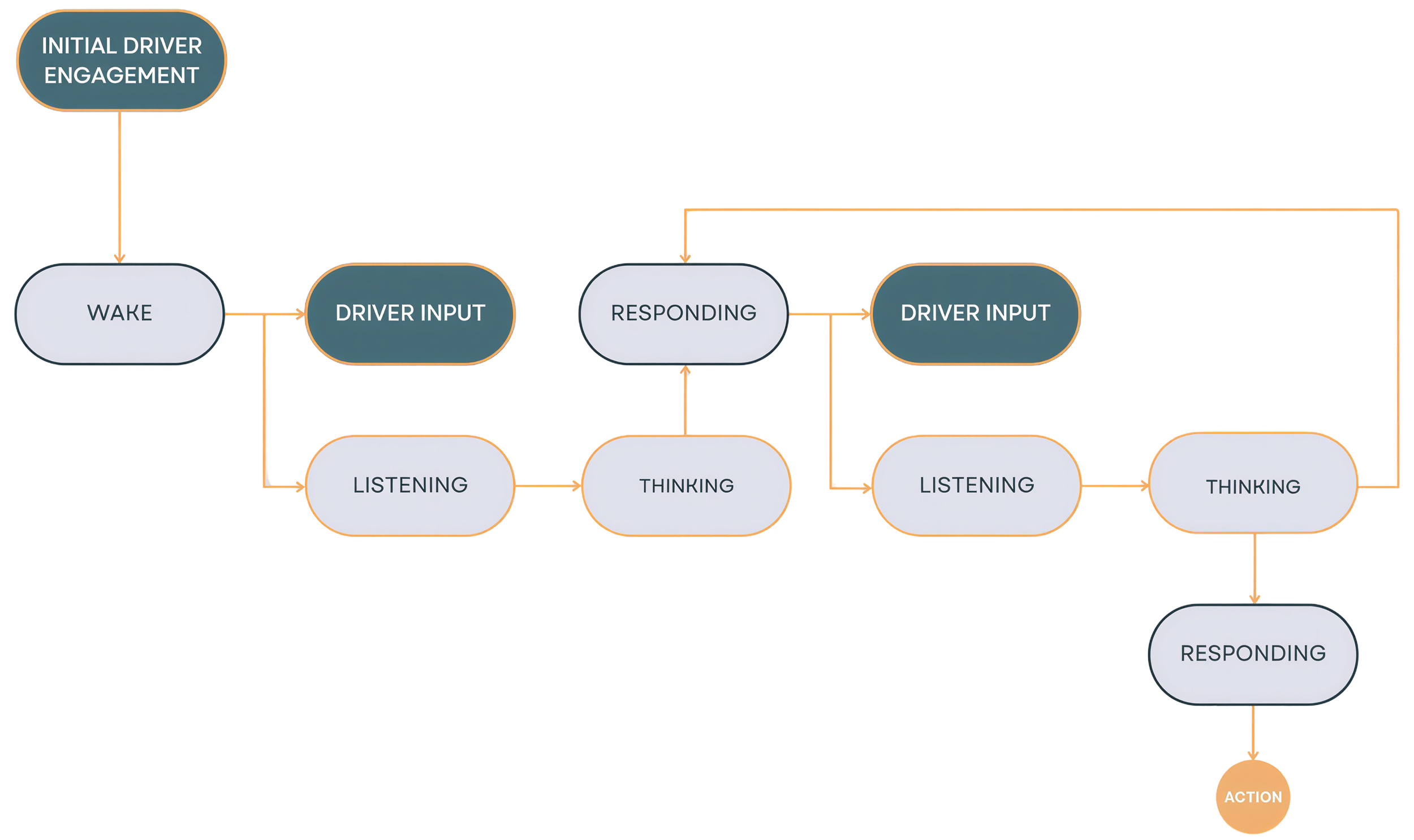
Example Flow of AI State
-
This means the accompanying sound should prioritize comprehension and clarity. Regardless of the juncture Peregrin is engaged or for what purpose, the driver should not expend unnecessary focus on deciphering the status of their interaction. For example, it should be clear when Peregrin is listening versus when Peregrin is generating output.
-
The multimodal cues serve to guide the conversation and provide necessary context where human body language or expression would otherwise be present. The speech component should pose real and consistent value to the driver while the underlying audio complements its helpful and decisive presence.
-
The system must be consistent in its personality and in the soundtrack and haptics that inform it. The emotional vocabulary of these different modes should be aligned.

Library
Photo by Eyosias G
State
Wake
Listen
To signify Peregrin has ingested the completed input from driver.
Driver finishes speaking.
Listening sequence completed.
Think / Generate
To convey Peregrin’s thinking state.
To indicate to the driver when Peregrin’s response is complete.
To initiate action posed to driver from the responding_continue audio.
Trigger
Peregrin’s name detected.
Since this sound is one that could potentially play as an extended loop even while in transit, I wanted to prioritize tranquility as a sonic theme and exclude the 155 MHz range, the common frequency for local emergency services. It also needs to be in congruence with the listening_complete sound and thus the dominant pitch corresponds with the G# the previous sound ends with. It is also worth noting there are two endings for this loop one signifying comprehension and one which will prompt the driver for clarification (success and failure respectively).
Respond
Though crucially complemented by haptic cues, these audio notifications represent the completion of Peregrin’s response to the driver’s initial engagement. Based on that response, Peregrin will either ask for confirmation on its next step (responding_continue) or will withdraw from conversation (responding_stop). I opted for an optimistic, open-ended chordal finish on the former so as to invite the driver to speak again. For the latter, I used a repeated tonic note to achieve an unembellished, more conclusive feel to lead into what is likely the sleep audio cue to follow.
Peregrin finishes responding.
Confirm
For the confirmation sound, I employed a slight fade in followed by a higher transient primary sound to illustrate the impetus of acting upon a given direction for the conversation. This could constitute changes to navigation or music and I tried to capture the spark that coincides with the excitement and positive nature of such a change.
Peregrin receives conclusive answer from driver regarding proposed action.
No action taken and no further assistance requested.
Incoming notification received to connected device.
Sleep
To conclude the interaction with Peregrin.
Peregrin going to sleep represents an opportunity for the sound to convey complete resolution. It is the end of the conversation and marks Peregrin's departure. I used granular synthesis to resample the startup sound into the major one (“I”) chord, a change sometimes referred to as the "Classical Resolution" to emphasize the purpose of this state.
Notify
Purpose
To denote Peregrin’s presence and affirm that its assistance workflow has been initiated.
To alert driver to a notification from the Sleep state.
Design Notes
I wanted a rounded tone that evokes warmth and collaboration with the driver. The frequency spectrum spans from high to low to signify the breadth of Peregrin’s AI functionality, and the subtle sus 2 to flat 5 motif represents both potential and comfort.
A subtle, unobtrusive, descending melody that establishes the topic of interaction and guides the conversation from listening to processing. It also helps establish turn-taking by setting a radio-style ‘over’ marker.
I elected to create short bursts of sound that will alert (but not alarm) a driver focused on operating a car. I avoided having the sound sustain so as to avoid detracting from other audio entertainment or navigation. I included two notification sounds because customization is common in this regard for differentiating the origin of platform where the notification is coming from. The choice to read aloud the notification could be administered via visual or haptic cues.
Audio
Headphones encouraged!

Sample Interactions

Sample 1: Start of Drive
This sample interaction demonstrates the utility of engaging Peregrin from the start of a drive for navigation. The wake sound illustrates the initiation and the confirmation sound concludes the process and indicates that the directions have begun. Sonically, both trend upwards in a way that, not only mirrors one another in terms of their inverse positions in the overall event sequence, but also in that they both pose a sense of beginning to the driver.
The primary concern when first sitting in the driver’s seat is often to get going as efficiently as possible. It is not uncommon though for this urge to be at odds with the competing desire to set up music and directions before embarking, and this sample interaction serves to display how this problem can be alleviated with a clear, concise audio workflow.

Sample 2: Mid-Drive Notification
This interaction shows the process for which Peregrin assists the Driver from the Sleep state when a notification is received. This flow prioritizes safety to mitigate the risk of enabling distracted driving by way of a low transient, low frequency notification sound that immediately dampens the music with a sidechain compression type effect rather than interrupting it or clashing with what was playing before.
Since this will inevitably introduce an element of inherent surprise, the option to respond can sometimes represent a decision that a driver was not prepared to make (especially while executing a turn as evidenced by the blinker in the background of this particular situation). As such, any extended listening sequence should exude patience and emotional consistency regardless of how long the driver has to direct his/her focus elsewhere. In this example, the inconclusive answer given triggers the thinking_loop_failure sound and leads to a clarification workflow that ultimately results in no action (illustrated with the responding_stop sound) and Peregrin returning to Sleep (illustrated with the going_to_sleep sound).

Reflections
Peregrin represents the potential for vehicle-native agentic AI to feature ergonomic sounds that are both artful and utilitarian, while prioritizing clarity, restraint, and ease of use.
Accessibility informs each decision, including the employment of conservative frequency ranges and clear volume hierarchies, and, though not featured in this installment, ideally will reduce multimodal isolation so that no single cue relies on sound alone. Although this is a mock system, the sonic language was intentionally kept harmoniously consistent across all states to reflect how real brands depend on internal coherence to build trust, recognition, and usability over time.
Thank you for listening and reading!